










Equitability
To be fair and impartial before being equal.
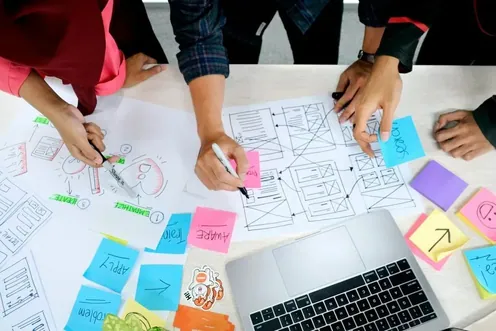
Programs designed with the cost per outcome right, before the budget locks.
Find out what people will actually do, before you build for what you assumed.
Purpose-built systems that work on the ground, not only on the dashboard.
Field operations that turn a plan on paper into work on the ground.
The Platform Commons License is a copyfair, source-available software licence. Code stays with the community, data stays with the individual, and platforms federate instead of walling each other off.
Proprietary software widened the income divide. Copyleft never paid the people who wrote it. Copyfair sits between the two: fair sharing, so the work reaches people, and fair commercialisation, so the work continues.
How we license our platformsTo be fair and impartial before being equal.
Ownership of code sits with the community. Ownership of data sits with the individual it describes.
Networked, interoperable platforms, so opportunity, knowledge and analytics travel between them.
Choice of visibility, of mobility, of markets and networks, and the choice to be forgotten.
The right of a community to set the rules of the platform it depends on.
An intellectual commons for anchor organisations, community-owned institutions and governments.
Coalitions for the commons, such as governments, cooperatives and social enterprises, form around shared code, opportunity and knowledge, and contribute back to the commons they all depend on. Sharing is encouraged for reach; commercialisation is encouraged so development continues.

Developing software is hard work, and it is lost when the invention ends up widening the divide it was built to close. The licence keeps nine of the ten open-source criteria and replaces free distribution with source-available: the software is open to the entities that share your vision.

The most valuable technology companies profit from their users' data. The people it describes should own it, and decide whether to donate, destroy or sell it. Software is judged by the people it reaches, not the data it gathers.

Organisations want code and data on their own servers, which otherwise builds a hundred isolated platforms each recreating the same content and workflows. Every instance joins a named federation instead, so users and opportunities discover each other across servers.

Knowledge drives a platform as much as its code. Anything created with public, government or philanthropic money is published under Creative Commons, BY-NC-SA 2.0 or BY-NC-ND 4.0.
Distribute or sell the work, or a derivative of it, as software as a service, with or without modifications.
Charge any stakeholder who benefits. Keep it free or near-free for the beneficiaries you built it for: at most a tenth of the closest comparable product.
Modifications, changes and new developments go back to the work, with changelogs, a self-audit each year and prominent notices on files you changed.
Enterprise and end users get a copy of this licence and the PCL Enterprise and End-User terms, through a click-wrap they can read.
No redistribution or resale of the platform itself without a written agreement with the licensor. SaaS is the path.
Personally identifiable information is never sold, gifted or given away. Non-personal data is monetised only with consent, and at least 80% of the benefit goes to the data owner within 30 days.
A perpetual, worldwide, non-exclusive, royalty-free licence to prepare derivative works, display and perform the platform publicly, and license it to enterprise and end users for non-commercial purposes, with attribution, and with the obligation to enforce the PCL Enterprise and End-User licences. The grant is irrevocable while the terms are met.
Each contributor grants a perpetual, worldwide, royalty-free patent licence. It terminates for anyone who brings patent litigation claiming the work infringes their patents.
The user or data subject owns their personal data and data wallet. The enterprise user is the data controller; the platform developer is only the processor. Personally identifiable information is not owned by the developer, the instance, the controller, the host or the funder, and can only be created or edited by the person it belongs to.
A Commons ID is a UUID unique across every platform in the federation, so a person is identified once rather than duplicated. Their data wallet holds their personal data and a copy of their transactions, stays in their custody, and lets them move from one instance to another.
Yes to both. Users and data subjects can request erasure: when the data is no longer needed, when consent is withdrawn, or when they object to the processing, and can port their data in a structured, machine-readable format to another organisation or instance.
Uniting with a named federation and its vision, and letting users, networks, content and opportunities be visible within it, subject to the privacy laws of the land. Users can transact with users of other instances in the federation.
The licensee governs its own users: maintaining changelogs and an annual self-audit, adhering to master data and interoperability standards, holding standards for products and services, resolving user grievances and auditing compliance where applicable.
It suspends provisionally on a formal acknowledgement from the foundation of a reported violation, or seven silent days after an instance owner is notified of a privacy breach, a data security breach or a fraudulent transaction. Redistributing the code terminates it automatically. Termination does not affect the rights of parties who received them from you, and their users get 90 days to move to another instance or opt out.
No. The work is provided as is, without warranties or conditions of any kind, and the licensor and contributors are not liable for damages. You may offer support, warranty or indemnity to your own users for a fee, on your own behalf, not the licensor's.
The laws of India. Disputes go to arbitration under the International Chamber of Commerce rules, in English, seated in Bangalore.
Attach the notice at the start of each source file: the platform name, its primary beneficiary, a line on what it does, the federation name, the year and the author, then the statement that the software is for the commons and licensed under the Platform Commons License as published by the Platform Commons Foundation, version x or any later version. We will give you the exact wording.
Three companions sit alongside it: the Contributor License for people who contribute to the work, the Enterprise User License for organisations running an instance, and the End-User License that protects the privacy and data of the people using it. Ask us for the text of any of them.
The licence was first published on 2 October 2019 by the Platform Commons Foundation, the organisation this studio grew out of, and is revised as new concerns arise. Every version carries a number, so you can pin the one you want or follow the latest.
Licence a platform with us
If you are a government, a foundation or a community-owned institution, we can license a platform to you under these terms, or build one with you that is licensed this way from the start.